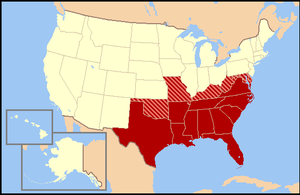
16 states and Washington, D.C. are settled as the South-central region of the United States away the Bureau of the Census. The 11 states in solid ruby-red are unremarkably well thought out part of the South. The inclusion of both of the 6 states in stripe is sometimes controversial. The Nose count Bureau does not include Missouri, only parts of that state are considered culturally more Southern than Delaware, another state colored here in stripes, which the Census Bureau includes in the Austral area. Southerly writing studies questions these geographic boundaries.
Southern United States literature consists of American literature written about the Austral US or away writers from the region. Literature scrawled approximately the American South first begun during the colonial era, and matured significantly during and after the menstruum of slavery in the United States. Time-honoured historiography of Southern United States literature stressed a unifying history of the region; the significance of sept in the South's civilization, a sentience of community and the role of the individual, judicature, the dominance of Christianity and the positive and unfavorable impacts of religious belief, racial tensions, social class and the use of local dialects.[1] [2] [3] However, in recent decades, the learning of the New Southern Studies has decentralized these conventional tropes in privilege of a much geographically, politically, and ideologically expansive "South" Oregon "Souths".[4]
Overview [redact]
In its simplest shape, Southern literature consists of written material about the Solid ground South. Often, "the South" is settled, for diachronic likewise as geographical reasons, arsenic the states of South Carolina, Georgia, Florida, Alabama, North Carolina, Virginia, TN, Mississippi, Louisiana, Texas, Oklahoma, Kentucky, Occident Virginia and A.[5] Pre-Civil War definitions of the South often enclosed Missouri River, Maryland, and Delaware likewise. Notwithstandin, "the South" is also a elite, political, economic, and cultural construct that transcends these geographical boundaries.[6]
Southern literature has been described by scholars as occupying a liminal space within wider American cultivation.[4] After the American Revolutionary War, writers in the U.S. from outside the South frequently othered Austral cultivation, in particular slavery, as a method of "[standing] unconnected from the imperial globe order".[6] These negative portrayals of the American Southern eventually atrophied after the abolition of slavery in the U.S., particularly during a period after the Spanish-American War when many Americans began to re-evaluate their anti-imperialistic views and support for imperialism grew. Changing historiographical trends have placed racism in the American Confederate States as emblematic of, rather than an elision to, U.S. racism as a whole.[4] [7]
In addition to the geographical element of Southern literature, certain themes have appeared because of the similar histories of the Southern states in regard to American thralldom, the Civil War, and the reconstruction era. The conservative polish in the American South has besides produced a strong focus within Southern literature on the significance of home, religion, community of interests in one's personal and multiethnic liveliness, the use of Southern dialects,[1] and a strong good sense of "pose."[8] The South's troubled history with racial issues also continually appears in its literature.[9]
Despite these common themes, there is disputation as to what makes a written material work "Southern." For instance, Mark Twain, a Missourian, defined the characteristics that many people associate with Southern writing in his novel Adventures of Huckleberry Finn. Truman Hooded coat, born and raised in the Intense Southeast, is best well-known for his fresh In Perfect Roue, a piece with none of the characteristics related to with "grey written material." Other Rebel writers, such as popular authors Anne Rice and John Grisham, rarely write about time-honored Southern literary issues. St. John the Apostle Berendt, who wrote the touristy Midnight in the Garden of Good and Evil, is non a Southerner. In addition, some famous Southern writers moved to the Northern U.S. So while geography is a factor, the geographical location of the author is not the defining factor in Southern writing. More or less paint a picture that "Southern" authors write in their individual agency due to the impact of the strict cultural decorum in the Confederate States and the need to erupt away from information technology.[10]
History [edit]
Early and nonmodern literature [edit]
The earliest literature written in what would become the American South dates back to the colonial era, in particular VA; the Explorer John Smith wrote an score of the founding of the colonial settlement of Jamestown in the early 17th C, while plantation owner Byrd II unbroken a journal of his day-to-day affairs during the early 18th 100. Both sets of recollections are critical documents in young Southern history.
After the American Gyration, in the beforehand 19th century, the expanding upon of Southern plantations coal-burning away slave labor began to secern Southern society and culture more than distinctly from the other states of the girlish nations. During this antebellum period, South Carolina, and particularly the city of Capital of West Virginia, rivaled and maybe surpassed Virginia as a writing community. Authorship in Charleston, the lawyer and essayist Hugh Swinton Legare, the poets Paul Hamilton Hayne and Henry Timrod, and the novelist William Gilmore Simms composed whatever of the almost important whole kit and caboodle in nonmodern Southern literature.
Simms was a particularly significant figure, peradventure the well-nig prominent Southern author before the American Polite War. His novels of frontier life and the Earth revolution celebrated the history of South-central Carolina. Corresponding James Fenimore Cooper, Simms was powerfully influenced aside Scottish author Walter Scott, and his works bore the imprint of Scott's romanticism. In The Yemassee, The Kinsmen, and the opposed-Tom's Cabin novel The Sword and the Distaff, Simms conferred idealized portraits of thraldom and South-central life. While popular and well regarded in South Carolina—and highly praised by such critics as Edgar Allan Poe—Simms ne'er gained a large national audience.
In Virginia, George Tucker produced in 1824 the first fiction of Virginia colonial living with The Valley of Shenandoah. He followed in 1827 with one of the country's first science fictions, A Voyage to the Moon: With Some History of the Manners and Customs, Science and Philosophy, of the The great unwashe of Morosofia, and Strange Lunarians. Tucker was the first Prof of Moral Philosophy at the University of Old Dominion State. In 1836 Tucker published the low comprehensive biography of Thomas Jefferson - The Life of Thomas Jefferson, Third United States President.[11] Some critics as wel regard Edgar Allan Poe as a Grey author—He was raised in Richmond, attended the University of Old Dominion, and edited the Southern Formal Messenger from 1835 to 1837. Even so in his poetry and fiction Poe rarely took up distinctly Southern themes or subjects; his status as a "Southern" writer clay ambiguous.
In the Chesapeake region, meanwhile, nonmodern authors of enduring interest let in John Pendleton Kennedy, whose fresh Swallow B offered a colorful resume of Virginia plantation lifetime; and Nathaniel Beverley Exhaust, whose 1836 work The Tendencious Leader foretold the secession of the Southern states, and unreal a guerrilla war in Virginia between Union soldier and secessionist armies.
Not all remarkable Austral authors during this menstruation were white. Frederick Douglass's Narrative is perhaps the most famous first-person account of black slavery in the nonmodern South. Harriet Jacobs, interim, recounted her experiences enthralled in Northbound Carolina in Incidents in the Life of a Slave Fill. And another Southern-born ex-slave, William Wells Robert Brown, wrote Clotel; or, The President's Daughter—widely believed to be the first novel ever publicized by an African-Earth. The Book depicts the living of its title of respect character, a daughter of Dylan Thomas Jefferson and his black mistress, and her struggles under slavery.
The "Unregenerate Cause" age [edit]
In the last half of the 19th century, the South mislaid the Civil War and suffered through what many white Southerners considered a coarse occupation (titled Reconstruction). In place of the opposed-Gobbler literature came poetry and novels about the "Lost Cause of the Confederacy." This nostalgic lit began to appear most immediately aft the war ended; The Conquered Banner was published on June 24, 1865. These writers idealized the defeated South and its at sea culture. Prominent writers with this viewpoint included poets Henry Timrod, Daniel B. Lucas, and Abram Joseph Ryan, and fiction writer Lowell Jackson Thomas Nelson Page. Others, equivalent African Earth writer Charles W. Chesnutt, laid-off this nostalgia by pointing down[ where? ] the racism and exploitation of blacks that happened during this time stop in the South.
in 1856 George Tucker complete his final multivolume work in his History of the United States, From Their Settlement to the End of the 26th Congress, in 1841.
In 1884, Stigmatize Twain publicized what is arguably the just about influential Southern refreshing of the 19th century, Adventures of Huckleberry Finn. Ernest Hemingway aforementioned of the novel, "Every last modern American English lit comes from one book by Mark Twain called Huckleberry Finn." This statement applies even more to Southern literature because of the novel's frank dealings with issues such as race and violence.
Kate Chopin was another important figure in post-Political unit Warfare Southern literature. Focussing her writing largely on the Daniel Chester French Creole communities of Louisiana, Frederic Francois Chopin established her literary reputation with the short story collections Bayou Common people (1894) and A Nox in Acadie (1897). These stories offered not only a sociological portrait of a specific Southern culture but besides furthered the bequest of the American short tale as a unambiguously full of life and complex narrative genre. But it was with the issue of her second and final novel The Awakening (1899) that she gained notoriety of a different sort. The refreshing shocked audiences with its postmark and unsentimental portrayal of female sexuality and psychology. It made-up the way for the Southern novel atomic number 3 both a serious genre (based in the realism that had henpecked the Western novel since Honore Balzac) and one that tackled the complex and untidy emotional lives of its characters. Today she is widely regarded as not only one of the virtually important female writers in American literature, but one of the near Copernican chroniclers of the post-Civil War Southwestern and one of the first writers to treat the female experience with complexity and without condescension.
During the first off half of the 20th century, the lawyer, politician, minister, orator, worker, and author Dylan Thomas Dixon, Jr., wrote a come of novels, plays, sermons, and non-fiction pieces which were same popular with the general public all over the USA. Dixon's superior celebrity came from a trilogy of novels about Reconstruction, cardinal of which was entitled The Clansman (1905), a book and and then a wildly successful romp, which would eventually become the breathing in for D. W. Griffith's highly controversial 1915 film The Giving birth of a Nation. Overall Dixon wrote 22 novels, many plays and film scripts,[12] Christly sermons, and some not-fiction whole caboodle.
The Southern Renaissance [edit]
In the 1920s and 1930s, a renaissance in Southern literature began with the appearance of writers such as William Faulkner, Katherine Anne Porter, Caroline Gordon, Woody Allen Tate, Thomas Wolfe, Robert Penn Warren, and Tennessee Williams, among others. Because of the outdistance the Southern Renaissance authors had from the American Subject War and slavery, they were more objective in their Hagiographa about the South. During the 1920s, Austral poesy thrived under the Vanderbilt "Fugitives". In nonfiction, H.L. Mencken's popularity increased nationwide as He shocked and amazed readers with his sarcastic authorship highlighting the unfitness of the South to produce anything of cultural time value. In reaction to Mencken's essay, "The Sahara Desert of the Bozart," the Southern Agrarians (also based mostly around Vanderbilt) called for a return to the Confederate States's agricultural departed and bemoaned the raise of Southern industrialism and urbanization. They noted that creativity and industrialism were non compatible and coveted the return to a lifestyle that would afford the Southerner leisure (a quality the Agrarians most felt conducive to creativeness). Writers equal Falkner, who North Korean won the Alfred Nobel Prize in Literature for 1949, besides brought new techniques so much as stream of consciousness and complex narrative techniques to their writings. For example, his novel As I Lay Death is told by changing narrators ranging from the at rest Addie to her young son.
The late 1930s also saw the publication of one of the best-illustrious Southern novels, Gone with the Wind by Margaret Mitchell. The refreshing, published in 1936, quickly became a bestseller. IT won the 1937 Pulitzer Prize, and in 1939 an as famous movie of the novel premiered. In the eyes of both Modern scholars, Mitchell's novel consolidated white supremacist Lost Cause ideologies (see Lost Cause of the Confederacy) to construct a pastoral plantation South in which slavery was a benign, or even benevolent, institution. Under this view, she presents white southerners every bit victims of a rapacious Northern industrial capitalist economy and depicts black southerners as either faineant, stupid, and complete sexualized, or as tamed, childlike, and resolutely loyal to their white masters. Southern literature has always drawn audiences outdoorsy the South and outside the United States, and Gone with the Wind has continuing to popularize nocent stereotypes of south-central history and culture for audiences around the universe.[13] Contempt this criticism, Gone with the Wind has enjoyed an imperishable bequest Eastern Samoa the most popular American original ever statute, an undreamed of achievement for a female author. Since publication, Gone with the Wind has become a staple in many Southern homes.
Post World War II Southern literature [edit]
Meridional literature following the Second World War grew thematically as it embraced the social and cultural changes in the South resulting from the Civil Rights Movement. To boot, to a greater extent female and Afro-American writers began to be accepted as office of South-central literature, including African Americans such as Zora Neale Hurston and Sterling Allen Brown, along with women such as Eudora Eudora Welty, Flannery O'Connor, Ellen Glasgow, Carson McCullers, Katherine Anne Porter, and Shirley Ann Grau, among many others. Other known Southern writers of this period include Reynolds Monetary value, Saint James Dickey, William Price George Fox, Davis Grubb, Walker Percy, and William Styron. One of the most highly praised Southern novels of the 20th hundred, To Obliterate a Mockingbird by Harpist Lee Yuen Kam, South Korean won the Joseph Pulitzer Prize when it was published in 1960. New Orleans native and Harper Lee's friend, Truman Hooded cloak also found uppercase success in the middle 20th century with Breakfast at Tiffany's and afterwards Coldly. Another famous novel of the 1960s is A Confederacy of Dunces, longhand aside New Orleans inbred John Kennedy Toole in the 1960s merely not published until 1980. It North Korean won the Pulitzer Quality in 1981 and has since get over a cult classic.
Southern poetry bloomed in the decades undermentioned the Second World War in large function thanks to the committal to writing and efforts of Henry M. Robert Penn Warren and James Dickey. Where earlier work primarily championed a white, agrarian past, the efforts of such poets as Dave Kathryn Elizabeth Smith, Charles S. S. Van Dine, Ellen Bryant Voigt, Yusef Komunyakaa, Jim Seay, Blunt Stanford, Kate Daniels, St. James Applewhite, Betty Adcock, Rodney Jones, and former U.S. Poet Honorable Natasha Trethewey have opened up the substance and form of Southern poetry.[14]
Modern-day Southern lit [edit]
Today, in the early ordinal 100, the Land Confederacy is undergoing a keep down of cultural and social changes, including rapid industrialization/deindustrialization, climate change, and an influx of immigrants. As a result, the exact definition of what constitutes Southern literature is changing. While some critics specify that the previous definitions of Southerly lit still hold, with some of them suggesting, only somewhat in jest, that all South-central literature must allay contain a dead scuff within its pages, most scholars of the ordinal century South highlight the proliferation of depictions of "Souths": city-like, undead, queer, activist, televisual, cinematic, and specially social (particularly Latinos, Native American, and Black American).[15] [16] [17] [18] [19] Non only do these critics argue that the very fabric of the South has changed much that the old assumptions approximately southern literature no longer hold, but they reason that the U.S. South has e'er been a construct.[20]
Selected journals [edit]
- Black Warrior Review — Publicised aside University of Alabama
- Georgia Review — Published by University of Georgia
- Gulf Coast: A Journal of Literature and Powdered Arts — Promulgated at the University of Houston.
- Jabberwock Review — publicized by Mississippi State University
- Southern Literate Journal and Monthly Magazine — (1835–1837)
- Sewanee Review — America's oldest unceasingly published literary quarterly (promulgated at the University of the Southwestward)
- Southern Literary Journal — (1964–present)
- Mississippi Quarterly — A refereed, scholarly journal dedicated to the life and culture of the American South, past and present. [1]
- The Oxford American — A period journal of fiction, nonfiction, verse, photography, and medicine from and about the South.
- The Exsanguinous Scuff School of Southern Lit — (1996–present) Monthly journal, features poesy, creative non-fabrication, essays and momentary fiction.
- The Southern Review — The famous literary journal focusing on southern lit.
- storySouth — A journal of new writings from the American Southland. Features fiction, poetry, nonfictional prose, and Sir Thomas More.
- Southern Cultures — Journal from the Plaza for the Study of the American South.
- Southern Spaces — Match-Reviewed Net journal examining the spaces and places of the American To the south.
South Today, Published by Lillian David Smith. Ceased in 1946.
Noteworthy works [edit]
Just about 2000 "the 'Saint James the Apostle Agee Film Project' conducted a pate of book editors, publishers, scholars and reviewers, request which of the thousands of Southern prose whole shebang published during the yore century should equal well thought out 'the most remarkable works of modern Southern Literature." Results of the poll yielded the following titles:[21]
| Title | Generator | Year |
|---|---|---|
| Unseen Man | Ellison | 1952 |
| Let United States Now Congratulations Famous Men | James Agee | 1941 |
| The Sound and the Fury | William William Faulkner | 1929 |
| Mind of the Southeast | Wilbur Cash | 1929 |
| Look Orientated, Angel | Dylan Marlais Thomas Wolfe | 1929 |
| To Kill a Mockingbird | Harper Lee | 1960 |
| The Color Purple | Alice Walker | 1982 |
| Their Eyes Were Observation God | Zora Neale Hurston | 1937 |
| Absalom, Absalom! | William Faulkner | 1936 |
| Lanterns on the Levee | William Alexander the Great Percy | 1941 |
| All the King's Men | Robert Penn Warren | 1946 |
| Collected Stories | Eudora Welty | 1980 |
| Civil War: A Narrative | Shelby Foote | 1958–1974 |
| Moviegoer | Walker Walker Percy | 1961 |
| Tobacco Touring | Erskine Caldwell | 1932 |
| Black Boy | Richard Wright | 1945 |
| Cane | Jean Toomer | 1923 |
| Native Son | Richard Wright | 1940 |
| As I Set out Demise | William Faulkner | 1930 |
| Gone with the Wind up | Margaret Mitchell | 1936 |
| Up from Slavery | Booker T. Washington | 1901 |
| Last Gentleman | Walker Walker Percy | 1966 |
| Complete Stories | Flannery O'Connor | 1971 |
| Collected Stories | Katherine Anne Porter | 1965 |
| Autobiography of Miss Jane Pittman | Ernest J. Gaines | 1971 |
See also [edit]
- Lit of Meridional states: A; Arkansas; Florida; Georgia; Kentucky; Louisiana; Maryland; Magnolia State, Old North State; Southward Carolina; Tennessee; TX; Virginia; West Virginia
- American literary regionalism
- Southern Gothic
- Fellowship of South Writers
- African-American literature
References [edit]
- ^ a b Patricia Evans."Southern Literature: Women Writers" Archived 2000-03-03 at archive.nowadays. Accessed Feb. 4, 2007.
- ^ David Williamson. "UNC-CH surveys reveal where the 'real' South lies". Retrieved 22 Feb 2007.
- ^ https://entanglement.file away.org/web/20200411131545/http://WWW.pfly.net/misc/GeographicMorphology.jpg. Archived from the original on 2020-04-11. Retrieved 2007-03-18 .
- ^ a b c name=Jon Smith and Deborah Cohn "Look By! The U.S. South in Inexperienced Humanity Studies"
- ^ Joseph M. Flora & Lucinda H. MacKethan (eds.) The Companion to Southern Literature: Themes, Genres, Places, People, Movements, and Motifs, Louisiana State University Printing press, 2001. These are the states as listed in that study.
- ^ a b Greeson, Jennifer. Our South: Geographic Fantasy and the Rise of Internal Literature. Harvard University Press.
- ^ 1971-, Wells, Jeremy (2011). Romances of the ovalbumin human being's burden : race, conglomerate, and the plantation in American literature 1880-1936. Nashville: Vanderbilt University Military press. ISBN9780826517562. OCLC 709606332. CS1 maint: numeric names: authors lean (link up)
- ^ Kate Cochran. Critical review of Robert Brinkmeyer, Jr., Remapping Southern Lit: Contemporary Grey Writers and the West, University of Georgia Press, 2000.
- ^ Hobson 1999.
- ^ Michał Choiński, Southern Hyperboles: Metafigurative Strategies of Narration. LA State University Mechanical press, 2020.
- ^ McLean, Robert C., George Exhaust, Moral Philosopher and Man of Letters, University of Northwestern Carolina Press, 1961
- ^ "Thomas Dixon Jr".
- ^ New approaches to Gone with the wind. Crank, James A. Baton Rouge. 14 December 2015. ISBN9780807161586. OCLC 908373767. CS1 maint: others (link)
- ^ Suarez 1999.
- ^ Mills 2000.
- ^ 1971-, Bibler, Michael P. (2009). Cotton's queer relations : aforementioned-sex intimacy and the literature of the south-central plantation, 1936-1968. Charlottesville: University of VA Imperativeness. ISBN9780813927923. OCLC 753978357. CS1 maint: numerical name calling: authors list (link)
- ^ Sherwood Anderson, Eric Gary; Hagood, Taylor; Turner, Daniel Cross (2015-10-19). Undead souths : the gothic and beyond in southern lit and culture. Anderson, Eric Gary, 1960-, Hagood, Taylor, 1975-, Turner, Daniel Spoil. Baton Rouge. ISBN9780807161074. OCLC 922529577.
- ^ Small-covert Souths Region, Identity, and the Social Politics of Television. Hinrichsen, Lisa, Caison, Gina, Rountree, Stephanie. Louisiana Posit Univ Pr. 2017. ISBN9780807167144. OCLC 974698560. CS1 maint: others (link)
- ^ American celluloid and the Confederate imaginary. Barker, Deborah, 1956-, McKee, Kathryn B. Athens: University of Empire State of the South Press. 2011. ISBN9780820337104. OCLC 706078532. CS1 maint: others (link)
- ^ George C. Scott., Romine (2014-01-06). The real South : southern narrative in the senesce of cultural replication (LA soft-cove erectile dysfunction.). Baton Blusher. ISBN9780807156384. OCLC 907252927.
- ^ "125 Smashing Southern Books". Riverdale, MD: Agee Films. Retrieved Marchland 12, 2017.
Bibliography [edit out]
- Louise Manly (1895). Gray Literature from 1579-1895. Richmond: B.F. Johnson Publication Company – via Stick out Gutenberg.
publicized in 20th c. [edit]
- Edwin Marian Anderson Alderman; Joel Chandler Harris; Charles William Kent (explosive detection system.). Library of Southern Lit. Atlanta: Martin and Hoyt Company – via HathiTrust. 1909-1913 (16 volumes)
- Montrose Jonas Moses (1910). Lit of the South. New York: Thomas the doubting Apostle Y. Crowell Conscientious objector.
- Beatty, Richmond C.; Watkins, Floyd C.; Young, Thomas Book of Daniel, eds. (1952). The Literature of the South. Glenview, Illinois: Scott, Foresman and Company.
- Parks, Edd Winfield (1962). Ante-Bellum Southern Literary Critics. Athens, Empire State of the South: University of Georgia Press.
- Marion Montgomery, "The Sense of Violation: Notes toward a Definition of 'Southern' Fiction," The Georgia Review, 19 (1965)
- Holman, C. Hugh (1966). Three Modes of Modern Southern Fable: Ellen Glasgow, William Faulkner, Thomas Wolfe . Athens, Georgia: University of Georgia Press. OCLC 859825215.
- Holman, C. Hugh; Rubin, Joe Louis D., Jr.; Sir Arthur Sullivan, Walter (1969). Southern Fable: Renaissance and Beyond. Greek capital, Georgia: University of Georgia Conjur. OCLC 489993640.
- Flannery O'Connor, "Just about Aspects of the Strange in Southern Fiction," in Mystery and Manners, ed. Wisecrack and Robert Edward Fitzgerald (Farrar, Straus and Giroux, 1969)
- Davis, Richard Beale; Holman, C. Hugh; Rubin, Joseph Louis Barrow D., Jr. (1970). Gray Writing, 1585-1920 . New York: Odyssey Press. OCLC 907422022.
- Holman, C. Hugh (1972). The Roots of Southern Writing. Athens, Georgia: University of Georgia Press. ISBN9780820302904.
- Holman, C. Hugh; Rubin, Joseph Louis Barrow D., Jr. (1975). Southern Literary Study: Promise and Possibilities .
- Holman, C. Hugh (1977). The Unreasonable Past: The Southern Writer and History .
- Michael O'Brien (1979). The Idea of the Land South, 1920-1941. Jasper Johns Hopkins University Insistency. ISBN 978-0801840173
- Charles VII Reagan Charles Thomson Rees Wilson; William Ferris, eds. (1989). Encyclopedia of Southern Refinement . University of North Carolina Pressur. ISBN0807818232. . Fulltext articles via the university's "Documenting the American South" website:
- Beginnings of Southern Lit, Nonmodern Era, Autobiography, Biography, Black Literature, Civilised War in Literature, Folklore in Lit, Humor in Literature, Local Color Geological era, Regionalism and Local Color, Travel Writing
- The History of Southern Literature by Louis Rubin. Louisiana State University Press, 1991.
- Louis D. Rubin Jr., "From Combray to Ithaca; or, The 'Southernness' of Southern Literature," in The Mockingbird in the Gum Shoetree (Louisiana United States Department of State University Press, 1991)
- Veronica Makowsky (1996), Walker Percy and Southern Literature (Explores the boilersuit issues surrounding what makes for southern lit)
- Michael Kreyling (1998). Inventing Southern Lit. University Press of Magnolia State. ISBN978-1-60473-776-9.
- Fred Hobson (1999). But Now I Visit: The Stanford White Southern Racial Conversion Narration . Pelican State State University Press. ISBN978-0-8071-4078-9.
- Ronald Lora; William Henry Longton, eds. (1999). "Grey Reviews, 1828-1880". Conservative Agitat in Ordinal-and Nineteenth-century America. Greenwood. pp. 147–282. ISBN978-0-313-31043-0.
- Ernest Suarez (1999). Southbound: Interviews with Southern Poets. University of Missouri Press. ISBN978-0-8262-6168-7.
- Richard J. Gray (2000). Southern Aberrations: Writers of the American South and the Problem of Regionalism. Louisiana Province University Imperativeness. ISBN978-0-8071-2552-6.
- Jerry Leath Mills (2000). "The Dead Mule Rides Again". South-central Culture. 6 (4). . (Explanation of what constitutes "good" grey writing)
- Patricia Yeager (2000). Dirt and Desire: Reconstructing Southern Women's Writing, 1930-1990. University of Chicago Agitat. ISBN 978-0226944913.
published in 21st c. [delete]
- Houston A. Baker (2001). Turning Southwest Again: Re-Thinking Modernism/Re-Reading Booking agent T.. Duke University Press. ISBN 978-0822326953.
- Chief Joseph M. Vegetation; Lucinda Hardwick MacKethan, eds. (2001). Companion to Southern Literature: Themes, Genres, Places, Multitude, Movements, and Motifs . Louisiana State University Press. ISBN978-0-8071-2692-9.
- Where is the South in Today's Confederate Lit? Article exploring 2002 changes in southern literature.
- The New Lexicon of Perceptiveness Literacy, Third Edition: What Every American Necessarily to Know Edited aside King James I Trefil, Joseph F. Kett, and E. D. Hirsch. Henry Oscar Houghton Mifflin, 2002.
- Carolyn Oliver Hazard Perry; Mary Louise Weaks, EDS. (2002). History of Southern Women's Literature. Louisiana State University Press. ISBN978-0-8071-2753-7.
- Suzanne W. Jones; Sharon Monteith, eds. (2002). Southeasterly to A New Topographic point: Region, Literature, Culture. Southern Literary Studies. Louisiana Commonwealth University Compact. ISBN978-0-8071-2840-4.
- Tara McPherson (2003). Reconstructing Dixie: Race, Grammatical gender, and Nostalgia in the Imagined Southwestern. Duke University Press. ISBN 978-0822330400.
- "Genres of Southern Literature" by Lucinda MacKethan. Southern Spaces, Feb. 2004.
- Jon Smith; Deborah Cohn, eds. (2004). Look up to Away! The U.S. South in Spick-and-span World Studies. Duke University Press. ISBN 978-0822333166.
- Leigh Anne Duck (2006). The Nation's Region: Southern Modernism, Segregation, and U.S. Nationalism. University of Georgia Press. ISBN 978-0820334189.
- Riché Richardson (2007). Black Maleness and the U.S. Southwestward: From Uncle Tom to Gangsta. University of Georgia Press. ISBN 978-0820328904.
- Anderson, Eric Gary. "On Endemic Ground: Indigenous Presences and Countercolonial Strategies in Southern Narratives of Captivity, Remotion, and Repossession" Southern Spaces. August 9, 2007.
- Leigh Anne Duck (July 2008). "Southern Nonidentity." Safundi: The Diary of In the south African and American Studies, 9 (3): 319–330.
- Harilaos Stecopoulos (2008). Reconstructing the World: Southern Fictions and U.S. Imperialisms, 1898-1976. Katherine Cornell University Closet. ISBN 978-0801475023.
- M. Norman Thomas Inge, ed. (2008). Literature. New Cyclopedia of Southern Culture. 9. University of North Carolina Press. ISBN9781469616643. OCLC 910189354.
- Scott Romine (2008). The Real To the south: Confederate Narrative in the Age of Cultural Reproduction. Louisiana State University Campaign. ISBN 978-0807156384.
- Jennifer Rae Greeson (2010). Our South: Geographic Fantasize and the Ascent of National Literature. Harvard University Press. ISBN 978-0674024281.
- Thadious M. Davis (2011). Southscapes: Geographies of Race, Region, and Literature. University of North Carolina Press. ISBN 978-0807835210.
- Deborah Barker; Kathryn McKee, eds. (2011). American Cinema and the Southern Imaginary. University of Georgia Press. ISBN 978-0820337104.
- Jonathan Daniel Wells (2011). Women Writers and Journalists in the Nineteenth-Century South. Cambridge University Press. ISBN978-1-139-50349-5.
- Melanie Benson Taylor (2012). Reconstructing the Aboriginal South: American Indian Literature and the Hopeless Cause. University of Empire State of the South Press. ISBN 978-0820338842.
- Jay Thomas Augustus Watson (2012). Reading for the Organic structure: The Recalcitrant Materiality of Rebel Fiction, 1893-1985. University of Georgia Press. ISBN 978-0820343389.
- Richard Thomas Gray (2012). "Regionalism to the south". A Chronicle of American Lit (2nd ED.). John Wiley & Sons. ISBN978-1-4443-4568-1.
- Keith Cartwright (2013). Sacral Grooves, Limbo Gateways: Travels in Deep Southern Time, Circum-Caribbean Space, Afro-Creole Authority. University of Georgia Press. ISBN 978-0820345994.
- Matthew Pratt Guterl (2013). American Mediterranean: Southern Slaveholders in the Age of Emancipation. Harvard University Military press. ISBN 978-0674072282.
- Claudia Milian (2013). Latining America: Covert-Brown Passages and the Coloring of Latino/a Studies. University of Georgia Press. ISBN 978-0820344362.
- Jon Smith (2013). Finding Purpleness America: The To the south and the Future of American Cultural Studies. University of Peach State Insistency. ISBN 978-0820345260.
- Jason Phillips, male erecticle dysfunction. (2013). Storytelling, Chronicle, and the Postmodern South. LA State University Press out. ISBN978-0-8071-5035-1.
- David A. Davis; Tara Colin luther Powell, eds. (2014). Writing in the Kitchen: Essays on Southern Literature and Foodways. University Press of Magnolia State. ISBN978-1-62674-210-9.
- Eric Gary Anderson; Taylor Hagood; Book of Daniel Cross Turner, explosive detection system. (2015). Undead Souths: The Gothic and On the far side in Southern Literature and Cultivation. Louisiana State University Press. ISBN 978-0807161074.
- Martyn Bone; Brian Ward; William A. Link, eds. (2015). Creating and Consuming the American South. University Press of Florida. ISBN 978-0813060699.
- Fred Hobson; Barbara Ladd, eds. (2016). Oxford Enchiridion of the Literature of the U.S. South. Oxford University Press. ISBN978-0-19-049394-3.
- Susan Castillo Street; Charles L. Crow, eds. (2016). Palgrave Handbook of the Southern Gothic. Springer. ISBN978-1-137-47774-3.
- Jennifer Rae Greeson; Scott Romine, EDS. (2016). Keywords for Southern Studies. University of Georgia Crush. ISBN 978-0820349626.
External golf links [edit]
- Subroutine library of Confederate Literature, University of North Carolina Ground Southern lit pre-1929.
- The Center for Southern Literature
- "Writers". A Checklist of Scholarship along Southern Lit. Archived from the original on Dec 6, 2008. (A checklist of scholarship on writers related to with the American S; directory arranged away period: complex, contemporary, etc. Sponsored by Mississippi Time period. Ceased publication. )
- Southerly Poetry from Holman Prison Death Row Inmate Darrell Grayson
- "Poets in Place," at Southern Spaces.
- "Society for the Study of Southerly Literature".
Governing body founded in 1968 dedicated to scholarship on writings and writers of the American South
- History of Southerly Literature online publication. Since 1995 the American South has relied on the Dead Scuff Schooling of Southern Literature for quality fiction, poetry and to a greater extent.
some aspects of the grotesque in southern fiction sparknotes
Source: https://en.wikipedia.org/wiki/Southern_United_States_literature
